
The EBLN “Through Traffic” Data Gap
A House of Cards ready to tumble?

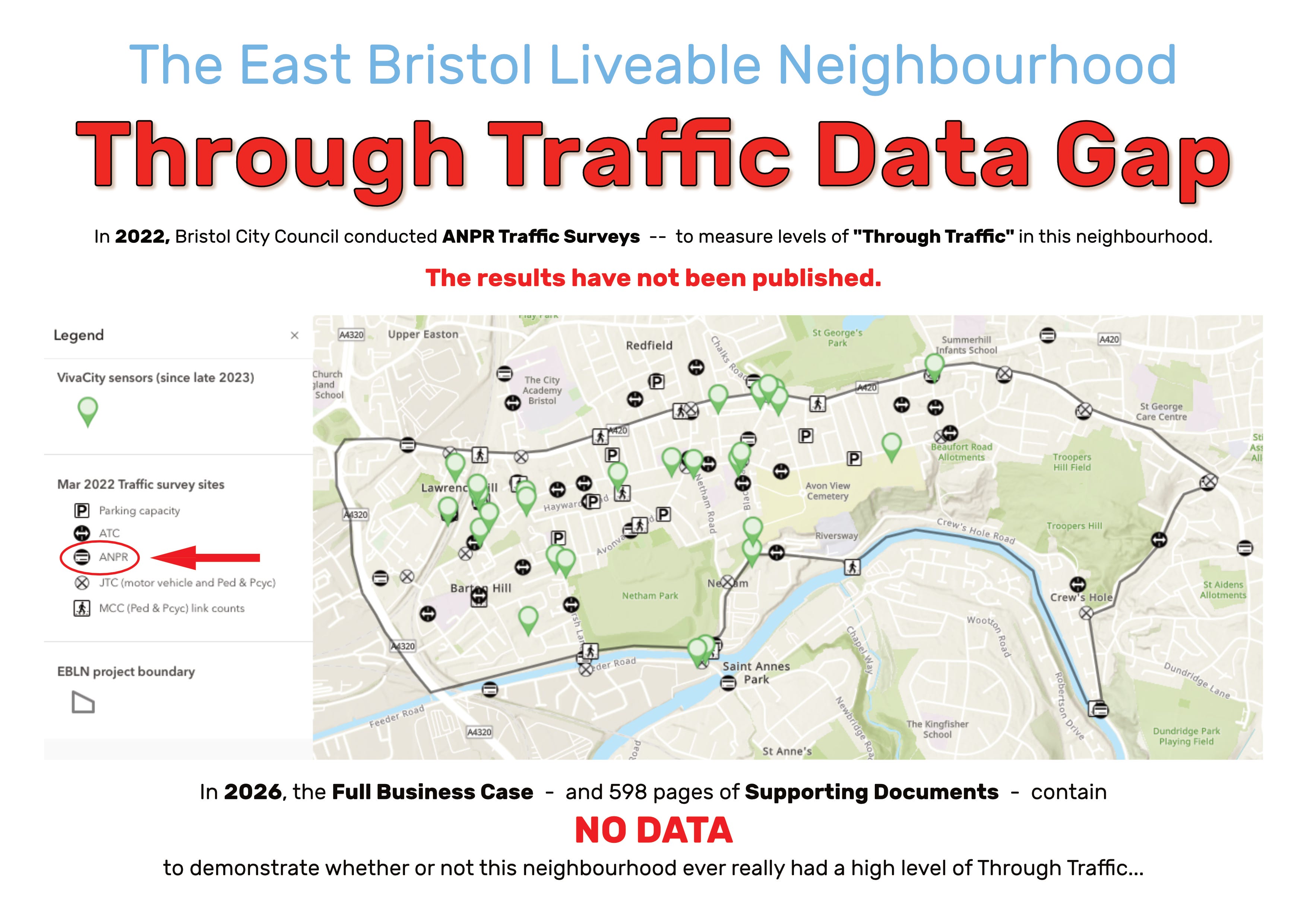
Yesterday I published a statement submitted to Thursday’s BCC Transport & Connectivity Committee meeting by Jesse Zyla, questioning the biased data collection methods being used to justify BCC’s Transport Department recommendation to make the East Bristol ‘Liveable’ Neighbourhood permanent. If you haven’t yet read it, please do now - it’s short and concise - and share as widely as possible.
Gerrymandered Traffic Data?

As this Thursday’s Transport & Connectivity Committee East Bristol ‘Liveable Neighbourhood’ vote rapidly approaches, members of the public have been digging into the data presented in the Full Business Case. The facts coming to light in relation to council claims around the achievements of the EBLN road blocks are gravely concerning.
The placement of traffic sensors used for the EBLN Monitoring Report is however not the only issue under scrutiny as the committee approaches its vote. Matt Sanders, dogged critic of transport policy at council public forums and contributor to this blog, has also submitted a statement for Thursday’s meeting, examining the (serious lack of) evidence for through traffic in the EBLN area.
Please read on…
THE “THROUGH TRAFFIC” RATIONALE
The DfT’s Statutory Guidance defines a Low Traffic Neighbourhood as:
“An area-wide traffic management scheme aimed at reducing or removing through traffic from residential areas, put in place using traffic signed restrictions or physical measures such as planters or bollards.”
So the RATIONALE for an LTN is to tackle Through Traffic, “cutting through” the neighbourhood.
Other Lovely Things may flow from this — like quieter streets, improved air quality, and a shift towards active travel.
But to achieve any of this — and to acquire funding — Through Traffic must be eliminated.
HOWEVER…
Blocking roads can lead to unfortunate SIDE-EFFECTS — for residents, relatives, carers, utilities, deliveries, emergency services, etc…
To use a medical analogy:
One way to persuade a patient to stop smoking, is to smother them with a pillow. And yes — when they are lying dead on the ground — they have stopped smoking.
But they have also stopped breathing.
So is that a legitimate result…?
THEREFORE…
The EBLN’s modal filters — with their damaging side-effects — are only JUSTIFIED if there was a SIGNIFICANT problem with Through Traffic, in the first place…
THE 2022 TRAFFIC STUDIES
In 2022, the Council conducted traffic surveys at the locations shown on this map:
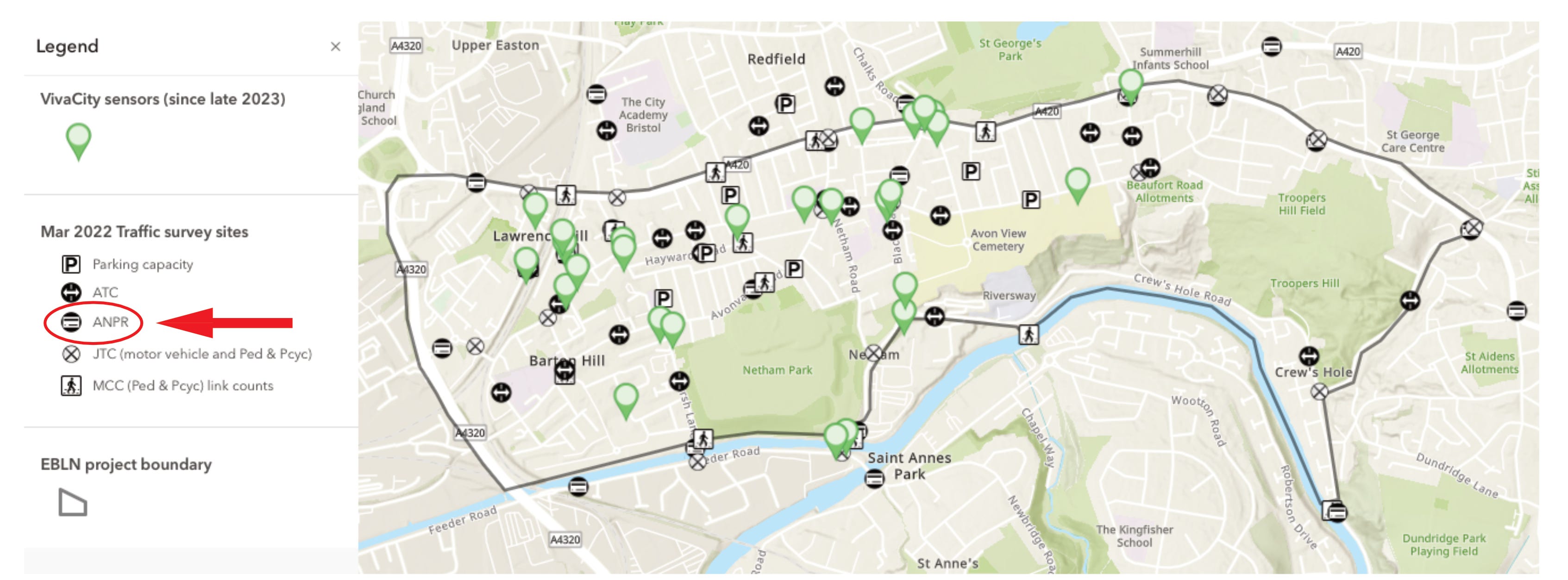
These included ANPR (Automatic Number Plate Recognition) surveys — where Number Plate information from multiple locations can be compared, to establish which vehicles are visiting local addresses, and which ones are “cutting through” the neighbourhood.
In 2024, ANPR surveys were done for the South Bristol Liveable Neighbourhood, and the spreadsheets published HERE.
However, the EBLN’s 2022 ANPR spreadsheets HAVE NOT BEEN PUBLISHED.
Surely — if this data demonstrated high levels of Through Traffic — then it was in the Council’s interest to sing it from the rooftops.
But strangely, that has not happened…
THE ABSENCE OF EVIDENCE
Of course, the absence of evidence is not evidence of absence. There was bound to be a certain amount of Through Traffic on these roads.
But the vital question is — HOW MUCH?
And the answer is — NOBODY KNOWS.

THE PUBLISHED DATA
The Council’s Monitoring Report used “Before & After” data from 2024 and 2025, to assess the EBLN Trial.
Issues which were monitored include:
traffic volumes of various vehicles,
numbers of cyclists and pedestrians,
bus journeys,
high-street footfall,
air quality, etc.
But NONE of the 124 pages contain ANY DATA about Through Traffic.
No numbers from BEFORE the Trial.
No numbers from AFTER the Trial.
No numbers to demonstrate a REDUCTION.
Because ANPR data was NOT GATHERED in 2024 or 2025.
The Monitoring Report DID NOT MONITOR Through Traffic.
THE “KEY OBJECTIVE”
The EBLN’s Outline Business Case — presented to Cabinet on 4th April 2023 — included this text:
“The key objective of the project is to reduce through traffic, improve walking and cycling provision, improve air quality and increase the modal share for walking, cycling and bus patronage for both local and commuting trips.”
This lists several worthy reasons to pursue the project.
But the MOST IMPORTANT “key objective” — the one which MAKES this a Low Traffic Neighbourhood — and wins the DfT funding — is: “to reduce through traffic…”
So the FIRST JOB was to establish HOW MUCH Through Traffic there actually was.
And perhaps the 2022 ANPR surveys did indeed establish high levels of Through Traffic, to JUSTIFY the scheme…?
If so, then surely those results will be highlighted in the Full Business Case…?
THE DATA GAP
The Full Business Case runs to 110 pages.
NONE of them contain ANY analysis of Through Traffic.
This meeting’s Agenda Item lists 20 Supporting Documents — comprising 598 pages.
NONE of them contain ANY analysis of Through Traffic.
— Except for…
THE “SUPPLEMENTARY MONITORING INFORMATION”
Document 18 is Appendix A3 - Supplementary Monitoring Information.
And Page 2 starts with:
“Members of the Transport and Connectivity Committee have requested various data in response to the forthcoming EBLN decision paper due at Committee on 9th July.”
And regarding Through Traffic, this document states:
“While there is no specific ANPR analysis of through traffic trips across EBLN, assumptions can be made based on the data collected. Traffic remaining within the zone can be assumed to be largely local resident movements, trade and delivery vehicles to residents and some through traffic in the form of taxis and buses etc. Hence subtracting post scheme flows from the monitoring report from pre scheme flows will give an indication of through traffic levels before the scheme was implemented.”
So this ANALYSIS of Through Traffic is based upon tenuous ASSUMPTIONS like this.
The document continues, with this claim about the Total Traffic Volumes measured in 2024 and 2025:
“Overall there was a 72-77% reduction on internal roads…”
But the “72-77% reduction” claimed in the Monitoring Report ONLY applies to the internal roads which were MONITORED by traffic sensors — all of which were located in close proximity to new modal filters, which prevented traffic from using those roads.
OTHER internal roads — which drivers were now forced to use INSTEAD — so which must have seen an INCREASE in traffic — were NOT MONITORED.
This “Supplementary” document implies that this patently MISLEADING figure can now be extrapolated — to conclude that most of the APPARENT “reduction” consisted of PREVIOUS Through Traffic.
The whole thing is a HOUSE OF CARDS!

AND FINALLY…
Before implementing this Liveable Neighbourhood, the Council had NO IDEA how many of the drivers using these roads were “CUTTING THROUGH” — and how many of them LIVED THERE — or were VISITING for legitimate reasons.
Yes — Through Traffic has been eliminated.
But how much was there in the first place?
Nobody knows.
Because NOBODY MEASURED IT.
But without that data, the entire scheme has NO JUSTIFICATION.
And meanwhile:
INCALCULABLE HARM has been inflicted upon the local residents.
Returning to the medical analogy:
Yes, the patient has been smothered with a pillow — so can no longer smoke.
But did the doctor ever actually ask — were they a smoker in the first place…?
Excellent question, Matt!
To end, I’d like to note that some East Bristolians did make an effort to show the world what the traffic on their residential streets was like before the implementation of the ‘modal filters’. Here, once again, is a video Katie Sullivan made on Victoria Avenue prior to the implementation of its modal filters, to be found on the East Bristol Open Roads Facebook group. Definitely worth a watch.
https://www.facebook.com/katie.sullivan.5203/videos/1588124052074659
Once again more damning evidence that EBLN was sold to the locals and Small business owners as a wonderful scheme that would be safer, greener for ALL, under a tissue of misleading data and blatant lies to fool people it would benefit everyone, knowing all the while that the daily lives of the vast majority of people in EB who are also drivers, would be negtively impacted, their journeys delayed and disrupted. BCC also lied about the duration of the scheme saying it was a trial. A trial means the scheme is reviewed after six months ie listen to peoples' legitimate concerns, brought no improvement in people's lives, and whose consensus was to remove EBLN, Council should have listened to feedback and acted and scrapped it immediately.