

Although it’s already a month ago, I am today bringing your attention to May’s Transport & Connectivity Committee public forum session, which you can watch from timestamp 3:20 in the above video. It is around 35 minutes long.
We all know that a public forum is more about allowing people a public space to let off steam regarding their concerns and grievances than actually enabling us to influence policy.
Nevertheless some of us tirelessly turn up with our questions and statements, sometimes the work of hours of research. Even if for the time being we are duly fobbed off with inadequate and often dismissive responses or remarks, we know at least that it will all be on the public record for future reference.
Still, the level of non-answering can at times be astonishing, and this is what I am highlighting in this brief post.
So on 14th May there some of us were again, attending for our half hour or so chance to Say What We Think and attempt to eek out a little more clarity from Transport & Connectivity Committee Chair Ed Plowden and the associated council officers.
A Question of Data
A couple of weeks previously, Bristol 24/7 had published this opinion piece by Matt Sanders, where he concludes:
Bristol City Council has no “traffic data” to confirm any quantity of vehicles “cutting through” the Southville zone – let alone “high numbers”. So those claims on the council’s website are a bare-faced lie.
Senior transport officers and the transport chair are well aware of this fact, and have repeatedly approved evasive and disingenuous responses to all enquiries
Without the claimed “traffic data” there is no justification for modal filters in Southville
So the modal filters have only been proposed in order to meet specific funding criteria and not because of proven issues within the Southville locale
By the time of the meeting the council had responded to this public scrutiny of the data by publishing two more data sets. The first (see here) was from Arup, a global consultancy company with a focus on ‘engineering the future’ of the built environment, and the second (see here) from The Floow, another global company, this time concerned with ‘nudging’ drivers into ‘safer habits’. Despite many questions to council and a FOI request from Robert Harakis this data had not previously been released, and appeared to be a hurried attempt to try to prove that the problematic traffic did indeed exist.
SBLN: Lies, Damned Lies, and Statistics

This is an updated version of a Public Forum Statement submitted by Southville resident Bobby Harakis, to the Joint Committee of WECA (West of England Combined Authority) on Friday 27th March.
Dismissive Responses
Along with many other issues, this publication triggered many questions to the May meeting. And many of these (often very specific) questions were sadly given generic copy and paste responses, completely failing to provide actual answers.
You can read them for yourselves here on the council website.
Here is just one example of many:
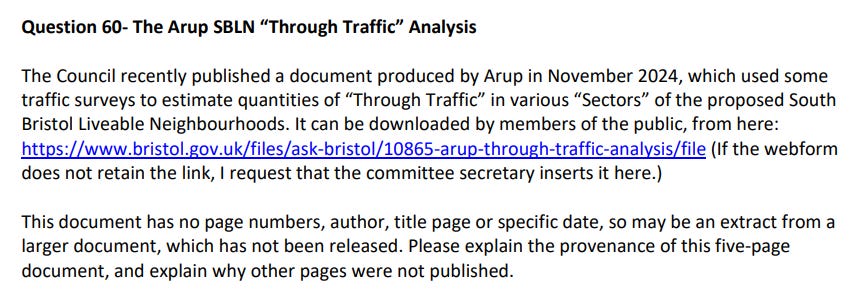
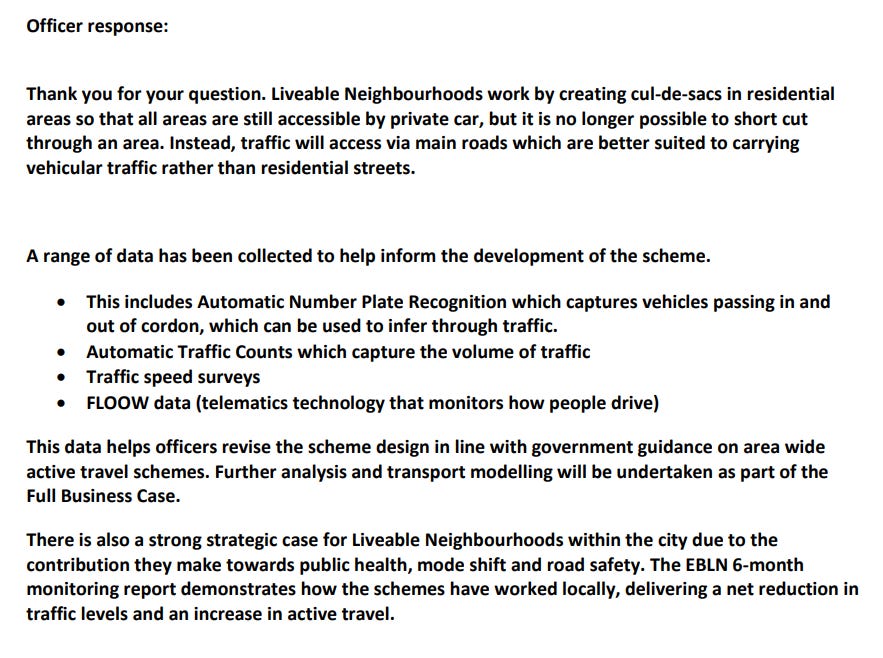
This copy-and-paste response, or parts of it, occurred 14 times, sometimes as the blanket answer to three different questions by the same person. It is propaganda for the schemes instead of an answer to the question.
Prior to the start of the forum, Executive Director of the Growth and Regeneration Directorate John Smith had attempted to ward off concerns by stating that public questions are taken seriously, with 126 having been answered in preparation for this meeting. He implied that this was quite an achievement considering the ‘tight deadlines’ they are faced with.
I chose to address this issue in my spoken statement - noting that nevertheless the non-answers were not honouring the spirit of, well, basically answering the damned questions members of the public had made the effort to ask.
Transport Chair Ed Plowden responded:
We do take these very seriously. We are determined to be publicly accountable and to enable scrutiny but it is very difficult when these come in on a Friday and we need to answer them within a certain amount of time, so we’ve done our best.
Katie Sullivan was also concerned, as well as prepared, asking as her first supplementary question:
I asked AI to analyse the answers to the public forum after I read every answer to the questions you gave, and its verdict was 75% of questions failed to receive answers; heavy reliance on repetition with 56% of answers using identical copy and paste text; frequent circular referrals back to the data pack that residents had already deemed insufficient that led them to ask their question.
Why do you believe it is acceptable to provide dismissive responses that fail to answer questions rather than answer them properly in good faith?
To which Ed responded:
We make every effort to answer the questions. Sometimes the volume of the questions means that we provide something of a generic response…
So how seriously exactly is ‘very seriously’, and what does ‘every effort’ really mean? We know that council officers, like most of us, have a lot to do. We also know that the bureaucratic machine is so clunky and inefficient that vast amounts of time and resources are dissipated uselessly into the ether.
But still, to so blatantly not answer so many very clear questions did not even have a semblance of taking them ‘very seriously’, or putting ‘every effort’ into the exercise. If that is really the best they can do then it is not only immensely disappointing but very disrespectful towards the very people the council is meant to be serving (if we are still under any illusions that this is how it works…). We are basically being told that our concerns and desire for transparency are not the priority.
After responding to Katie’s question, Ed then appeared to offer a solution, suggesting people submit their questions again as soon as possible, via email, because the longer they have to answer them the better the quality of the answers will be - though there was no indication as to the form these answers would take or the exact timeframe involved.
If anyone reading this submitted questions that received unsatisfactory responses but has not yet already done so, please do email them to democratic.services@bristol.gov.uk, mentioning Ed’s clear invitation to do so at this last T&C Committee meeting.
If anyone has already followed up on this please let us all know what responses, if any, you received in the comments below.
The debacle is in any case a clear admission that the current system of enabling democratic scrutiny via the ‘democratic service’ of the public forum is not fit for purpose.
The more important an issue is for the public, the more submissions committees will receive. “We ran out of time so had to copy and paste” completely fails to acknowledge and honour this fact.
If you don’t have time, as you indicate, then what is the point of the public forum ritual, and why is it included under ‘democratic services’? ‘We don’t have time’ is basically saying, ‘you - the people we are accountable to - are not a priority’.
It is particularly ironic coming from a committee concerned with “connectivity”.
There needs to be a robust and transparent structure for providing satisfactory answers to urgent questions on contentious policy issues.
This would surely be in any council’s own interest if it wishes to move forward with as little friction as possible.
Postscript
I’ll hand this over to Judith Worthington, whose written statement (number 4), may resonate:
Title: No to Victorian times in 2026
I’m getting really tired of hearing this argument that because Southville’s streets were built in Victorian times, we should all just 'go back' to how it was then. It’s a total romanticisation of a time that was actually pretty miserable for most people.
Back then, people only 'walked everywhere' because they had no other choice. It wasn't some green utopia; it was an era of coal smoke, zero street lighting, and practically no access to doctors or dentists unless you were wealthy. If you got ill or had an emergency, you were basically stuck, as going to hospital back then was a last resort.
We’ve spent over a hundred years moving away from those conditions for a reason. Society has moved on, but these 'Liveable Neighbourhood' plans seem to ignore how people actually live in 2026.
We don't have a doctor locally anymore—our hospitals and specialist clinics are miles away, and you can’t exactly expect an elderly person or someone in pain to hop on a bike or walk miles to get there.
Southville is serviced by only one bus twice an hour which is inadequate for most people’s needs—in particular the elderly and those with mobility restrictions. For most people in Southville, a car isn’t a luxury; it’s a necessity. I’m thinking specifically about women travelling home alone late at night who don't feel safe walking through dark streets, or our elderly and disabled neighbours who would be effectively housebound without car access.
These schemes might look nice on a map, but they risk turning our streets into posh prisons for anyone who isn't young, fit, and able-bodied.
We need a transport system that works for the 21st century and looks after everyone—not one that tries to force us back to the Victorian ages.
Post-democratic, taking their lead from Starmer's hated government. It seems every institution of the state is doing what it likes, and that past norms and protocols have been consigned to history.
Thank you for keeping the pressure on BCC.
They can't answer questions of logic because they're serving the hidden hand behind Agenda 2030. Check out how this is panning out in the UK:
https://youtube.com/watch?v=YHG-jNPSrhY&is=JkZQwmhoZwOn_81N